Wednesday, April 21, 2010

Dialogue Editing

In this article I am going to talk about the importance of Dialogue Editing, what it is, and how everyone on set can be aware of its possibilities, and what they can all do to make it go smoother so your film turns out better in the end. But before I get into that, I want to address a small thing that can really make all the difference in the world regarding the mixing process of a film.

If you hired a sound guy who knows what he's doing, he probably recorded all of the audio in 24 bits, as opposed to 16. But when the editor starts up their session, it sometimes defaults to a 16 bit session, and the editor either doesnt know the different, or forgets to change it to a 24 bit session. So all of those nice high def audio files recorded on set are being reduced to almost CD quality (which is low)! Be sure that the editor knows to run their session in 24 bits so that you arent handing a lower quality project to your post sound guys after editing.

For those of you who dont know, 24 bit vs 16 bit is the equivelant of having a fader on a mixer that is one inch high as opposed to three inches high. For you video people, its like DV vs HD. If you were trying to mix something with the small fader, you would have less room to really get that track into the mix. But if you had a larger fader, you would have more room for the sound to lay in its place and really dial in where it needs to be. Litterally speaking, we are talking about dynamic range, which is how much room you have between silence and distortion (how loud your signal can get). 24 bits gives you a lot more head room, so your signal is less likely to distort. And it sounds more natural, because it is less compressed than 16 bits. So be sure to keep this in mind.

Now, on to Dialogue Editing!

On set you usually have a number of different takes for a particular scene. In this example, I'm going to talk about a simple "two shot" scene, using one camera. 

Usually you would have your two actors facing eachother, and the camera is looking at one of the actors at an angle. The sound guy would normally mic up the actor that the camera is recording. Then when the director feels you have a good take, you do the exact same thing again, except the camera is facing the other actor, and likewise the sound guy is miking up that actor as well.

In editing, your film editor resyncs the audio for each take with the picture, decides which is the best take, and pieces it together, cutting between the two angles to show the conversation. Simple enough right? In theory, but there are a couple of things that can change the outcome.

Often times when filming a two shot, the set is nice and quiet for one angle, but then it gets noisy for the other angle. So when you cut between the two, one actor always has a lot of background noise, and the other doesnt. How do you avoid this? Well, sometimes you cant. But what your editor can do is go through all of the takes of that noisy scene and put a couple of the better audio takes on an ALT track in the session, so when it is handed off to the dialogue editor, they can go in and resync the audio to get a cleaner take.

Another problem that can occure is when the actors are allowed to improvise. If they are improvising, chances are you will have a very hard time piecing together a cohesive conversation, and if they have two different conversations for both angles of the same shot, you can really run into problems. I worked on a film once where this was the case, and the director/producer decided that for one segment they wanted the actor who wasnt on camera to be speaking during a two shot while we were looking at the other actor. The problem was that we never got a good take of the question being asked in the scene because the only time the question was asked was when that actor was off camera, so they clearly sound like they were far away from the mic, whereas every other time they spoke they werent. There was no budget in this film for ADR, so we had to live with it. If the actors hadnt improvised, we could have easily found a good take of that question and layered it over the scene to get a good version of that dialogue; another thing less experienced editors wouldnt know to do.

Another thing that we try to avoid is having actors step on eachothers lines. I know that sometimes the script calls for this, but it is hard to pull off and get good sound if youre on a low budget film, and you are only using a boom with no lavs. If the actors dont step on eachothers lines, the effect can be achieved in editing with little difficulty, and your audio tracks can be overlapped as needed.

A different thing one runs into is when let's say two actors are having a conversation, and again you are using one camera, and a boom. One actor is sitting at a table, the other is preparing something in the kitchen. The actors both usually go over their lines and have their conversation during both of their shots. Now, imagine in editing, you decide to focus on the actor preparing something in the kitchen while the seated actor talks. As far as audio goes, you have a choice of getting the sounds the actor in the kitchen is making, whith the voice of the other actor far away, or just the voice of the other actor, and no kitchen noise. Which do you choose? Well, I always tell the actors that it is best to do a quick run through and know how long the other actors lines are going to be, or give them some sort of signal once they are done so that they know when to respond. This way, when the descision in post is made to stay on the actor in the kitchen, but have the dialogue of the other actor be heard, you can still get a good signal from both actors and not compromise the situation. Just stick both takes on different overlapping tracks, and have your post mixer make it sound good!

These are just a few small examples of how everyone on set can work together as a team to ensure that your film turns out sounding great, regardless of how small the production is. Your dialogue editor will be very greatful, and as always, a happy crew is a hard working crew! That includes post!

Tuesday, March 2, 2010

Lavs Demystified

What are Lavs? Well, basically they are tiny mics that you clip onto your actors so that you can get audio from them when you dont have a boom, or cant get it close enough. Lav is short for the word "Lavalier" which in French means pendant or a kind of jewelry that would be clipped on like a broach.


Good sounding lavs can be very expensive, complete with a wireless transmitter and receiver easily cost over a grand each, but you can find cheaper ones. Those however are usually used for conferences and things where all you need to be is heard, and the quality of the audio isnt necessarily that important.

But it is possible to use lavs without the wireless setup. The catch is that now theres a wire involved that you have to run underneath your actors clothing, and all the way through the set to your sound mixer's mic input. This method isnt very common because lets face it, the actor doesnt want to be tethered to anyone, and having cables throughout the set can be a safety issue, let alone the fact that it may get in the shot! But using lavs wired is a good way to avoid all kinds of potential problems that can occur when using a wireless system.

Almost all lavs use wideband FM (Frequency Modulation) modulation, which means that they work like radio waves. The problem in this case is that they can often be using the same signal as a number of other wireless devices including other communication devices. On a good lav system you would have the option of scanning through the available frequencies to use, then set your transmitter and receiver to an open frequency. On some of the lower end models however you dont have this option, or if you do, you only have the option of using one of several frequencies, if the frequency isnt just set by the manufacturer.

Another issue is that if your actor has to continue his/her dialogue through lets say walking into other rooms, and the receiver (which should be with the sound guy) stays in the initial room, theres a chance that the signal can cut out. If you have ever seen Francis Ford Coppolla's "The Conversation", you see a high tech (for the time) sound guy/spy who has bugs in various places, picking up a conversation two people are having in a park. But they are walking around, and theres all kinds of things getting in the way. Later on you see him taking his various sources and making a compiled mix of the conversation the two people were having, and you hear his source tapes cut in and out. This sort of thing actually happens, though it usually takes thick walls or led paint to cut the signal completely.

The other downside to using lavs is that since they are to be clipped onto your actor, you have a high risk of getting clothing noise from your actor's movement, indirect audio because maybe the clothing your actor is wearing doesnt allow for a hidden mic clipped anywhere close to the bottom center of the neck (these two are usually the most common problems), and of course, poor sound quality because the mic is so small. They also eat batteries faster than you could imagine, and they only take good brand name batteries! I have also had interference because I could hear the actors heart beating over their dialogue!

Also, a good thing to know is that a lot of lav mics are omni directional if you are using one type of clip, and cardioid when using another. This can be the difference between an extremely high noise floor, and a good clean signal. The lav mics themselves often come in a little package with a number of different types of clips, so choosing the right clip is very important because the outcome of your audio is at stake, and there is usually nothing written anywhere to tell you this. A qualified Audio Engineer who has a good knowledge of microphones and electronics can tell just by looking at it, but most people just see several different clip options.

So with all of these negative aspects of using lavs, why bother? Well, as I mentioned in a previous article, lavs are a good backup system. Sometimes the boom just cant get close to the actor because maybe the scene requires a wide angle, or maybe the location doesnt allow for the boom to get close. This is a very normal problem on set, because "on set" doesnt necessarily mean you are in a film studio. Also, lavs can often pick up some good low end frequencies in an actors voice that may be desirable in the mix. Some actors are well known for their voice, and if the boom isnt picking up that low end, the voice might not be recognizable as that of the actor. In any case, it's always a good idea to have a backup if you can squeeze it into the budget, and your post sound guy will appreciate the options.

I work a lot in post as well, and it is nice to have multiple sources. I once worked on a film where we were shooting with the RED ONE camera, and they wanted to record the audio directly into the camera so they wouldnt have to re sync it later. Now, I have a lot of experience with that camera, and although it looks good and it's interchangeability is a cool feature, they really phoned it in when it comes to sound, which is why I recommend always recording to a different source, and to just not bother with the RED's audio. But in this case, that is what the producer wanted, and he wouldnt take "no" for an answer. So, knowing this, I said to him "then we're going to need a mixer with direct line outputs for each input". We were using three lavs and a boom, with a Sound Devices four-channel mixer, which provided direct line level outputs (I'll talk about the difference between line level and mic level in another article), because I wanted to avoid using the RED's mic pre amps. 

So even with all of this precaution, the RED (which can accept up to four analog audio sources, and record four separate audio tracks) still managed to distort most of the audio (though it was not audible at the time), which we found out once in post production. However, since we had multiple takes, and multiple audio sources, I was able to piece together the dialogue in the end and the difference was night and day. Initially, I thought we were going to have to ADR the whole film! But I was able to save the day (and the actor's patience!) by my use of all of these sources (I'll talk about Dialogue Editing in another article).

So I hope that this article was enlightening on what lavs are all about, and why they are a good idea to have, but not to rely solely on.

Friday, February 26, 2010

Audio and Visual Perception

When you look into a camera from across the room, and you are using a wide angled lens and things are well lit, you can see the whole room. Simple right? Well the same philosophy doesnt apply to sound. Anyone who has used a camera with it's built in mic knows that. If you are interviewing someone up close, that built in mic can be adequate if it's a quality mic. But as soon as you step back, the quality of the audio goes down dramatically. It gets "roomy" or "boxy", and often times the background noise level (Noise Floor) goes up, making the already poor sounding dialogue harder to hear. How do we avoid this?

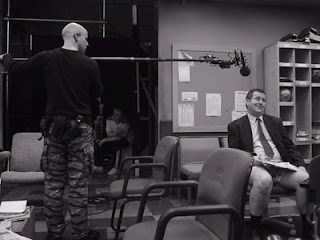
You've seen plenty of times the guy with the long boom pole and the headphones. Thats usually the best answer. Simple right? Get the mic close to the source of sound, ie: get the mic close to the actor's mouth. This makes sense right? Thats why a singer sings into a microphone, and not just in the general area of the mic. The closer you get the mic to the source of the desired sound, the better that sound quality will be because you then can turn down the mics input level (Gain), which will reduce the Noise Floor.

For Filming purposes we usually use what's called a shotgun mic on a boom pole. I wont get into the technical jargon on that, but do know that it is a different kind of mic than the kind you would use to sing into. It is a specialized microphone, and can generally serve for only this purpose, though a creative sound guy could use it for other reasons as well. But generally speaking, a shotgun mic is supposed to be able to pick up audio in a straight line from the tip onwards, with it's pickup range gradually getting wider and less sensitive. So the closer you can get that mic to the actor's mouth without being in the shot, the better.

Fortunately most of the time shots are pretty narrow, so you can get in pretty close. Shotgun mics provide the best sound, so you want to use them whenever you can. But sometimes the shot is wide, and you can't get the mic in close enough to pick up a good signal. What do you do then? Well, there are two options:

1: Use lavs. Lavs are tiny mics placed on the actor. Some are wired and go directly to the sound mixer, some are wireless and have bulky transmitter packs that too need to be hidden on the actor. Lavs are very expensive, and dont always sound as good, but are a good backup system in case the boom cant get a good signal.

2: ADR. Automatic Dialogue Replacement (though far from being automatic) is a last resort for a number of reasons. It costs money to do it (and not a lot of facilities do ADR, or have experience doing it), actors dont like doing it (assuming they have any experience doing it), you lose the performance in the actors voice more times than not, and you have to go in and re create that scene a lot of times from a sonic perspective, which is tedious and expensive.

So as always, it comes down to making sure you do things right the first time around, instead of wasting time and money for everyone involved. And again, the best way to get good production audio is to hire a professional staff and ensure that not only are conditions ideal for sound recording, but the proper equipment is available.

Financing an Indie Film

You may ask yourself: "what does this have to do with sound?"

Well, if you read my last blog, you know!

So where does the money come from? Well, you may remember me talking about assets. These are things that your film contains that may provide funding for your film. A good example of an asset is the cast. Do you have any big names among the cast? In this case, things are easy. All your producer has to do is find someone with some money who would be interested in financing your film.

Why would they do this? Because maybe they want to be friends with the actor. Maybe their son or daughter wants to be an actor/actress, and playing alongside a name actor could be a career booster. Maybe they just want to feel like they are a part of the film team, or maybe they are simply interested in the revenue that the film is expected to generate.

This scenario isnt very realistic for really low budget indie shorts or student films, but it should get you thinking about assets, and why a person or organization would be interested in giving you money to make your film.

One Example: A friend of mine wrote a film as a student thesis about a legend that happened on a border town in Texas. Now, this wasnt a "La Llorona" kind of legend, where the town didnt want to have anything to do with it. It was one of those legends or stories where tourists were drawn to the town to see where it happened. So here we have an asset, and an interest. If this film is made, the possibility of increasing the towns touristic appeal/awareness is there, so the town has a vested interest in this film. So he (my friend) contacted the city council, proposed his business plan, and got funding for his film. The town even wanted to use the film in their museum, so now we're talking royalties!

With this sort of asset and future for the film, you can now turn that around and get other people interested in your film. Maybe the town payed for the film to be made, but you now decide that to do things right, you should go to the actual town to film. But the town is in Texas, and you live in California! With the above described scenario, you can generate more interest and provide additional funding for your cast and crews travel expenses.

Remember that when you are the Producer, you need to be thinking about the whole films expenses. This includes post production, which often takes much longer than shooting, and can often be very expensive. As an indie film maker or student, you can probably fill a number of these rolls, or have friends that want to help, or have favors that you can call on. But remember, you want to do a good job, so make sure that the producer or director is overseeing everything.

So what other kind of assets does your film have that might interest a person or organization? Well, as an indie film or thesis film, there is a lot of grant money out there waiting for someone like yourself to take advantage of it. You just need to know where to look. Good thing we have Google these days, if you can't research this kind of thing on your own, maybe you shouldnt be making movies! lol

But basically, organizations and individuals provide grant money for the arts for two reasons: tax write-offs, and to appear like they have taste and support the community and refined things like art.

Ive worked on countless films where the producer was able to obtain with little difficulty funding from grants for the arts or student film makers, and nothing was expected from them in return other than to actually make the film. The interest there is that at the end of the film in the credits, the name of their organization will appear. So when your film does the festival circuit, people will see that. So basically they just paid for a commercial that may eventually find its way to screenings all over the world and internet, DVDs, maybe a short film compilation DVD. Thats advertising!

So what about financing for Feature Indie films? You know, ones with big budgets! Did you know that a great number of indie features are shot for between 1 and 50 million dollars! Thats as much as or close to big budget studio films! The only difference between the two kinds of films is that one is backed by a major studio (like Sony, Warner, or Universal), and the other is backed by...you! So it's up to you (the Producer) to go out there and find funding.

For funding a big budget film, you need a lot of dough. So to figure out how much that is going to cost, this is going to require a lot of research. So get quotes from all the staff you are going to need, as well as wages for your actors. Also make sure to include meals, rentals, location and transportation costs, props, all staff (crew), and post production. Just figuring out the costs is a great undertaking in it's self, so while you are doing that, see how much you can reduce your costs. I know this goes against what Ive been saying, but interns are a good way to keep costs low, in some instances, just not when it's going to be a huge part of your film! Maybe they can help cater, or do assistant work. That sort of thing. I'm sure there are a number of people that are just trying to up their IMDb credits for their resume, and working on a feature film is good credit, so some holes can be filled by this. Others are going to be more difficult. With renting equipment, you may get discounts for package deals, or because you are on good terms with the rental house. Most rental houses have a daily rate they charge for equipment, but they often only count the weekend as one day, since they are themselves normally not open on sundays. So weekend shoots are a good way to go.

A lot of the cast and crew however won't work for free because they are trying to make a living too. But some are willing to work for deferred pay, which means that if you know money will come after production is done, they get paid then. Or, if by chance the film makes money, they get a percentage of the film, often to a certain point, or once an agreed upon number is reached.

What you need to understand is that if you want to offer me, the sound guy, deferred payment on your indie project, you are asking me to take a huge risk. If I dont have savings, I may lose my apartment because I spent all month working on this film that may or may not even pay me instead of working on paying gigs! So asking people to work on a deferred payment plan is very risky for most production crew and actors. Post production may be a little different, because these people may have day jobs, and can offer their nights to work on addition projects such as your own.

But anyone working on deferred pay is going to want to know about your assets, in particular if you already have distribution and press lined up, because their payment is based on money the film generates, not money generated to make the film. So that's risky business, and you risk making a lot of enemies if your cast/crew go unpaid due to your film flopping. And where you have enemies, you develop a bad reputation, and when you develop a bad reputation, no one will work with you, hire you, or rent equipment to you. So you have to find a new career!

The ability to pay your cast and crew on the front end is the best way to get quality production and keep people happy. The second best way is to provide good food on set! But that's not what we're here to discuss.

Money. Gotta get it. Who to ask? Well, who has a lot of money that may be interested in your film? Believe it or not, the best people to ask are people that arent related to the entertainment business. People who are wealthy by their own means, business, inheritance, whatever. The film industry is sexy from an outside point of view (and cut-throat within!), so people not related to the industry have a fascination sort of point of view. Not all obviously, but enough. Now why would a wealthy person fund your film? Assets, incentives, the prospect of making more money. All kinds of reasons. It's up to you to find them. Sometimes the best asset is already having a portion of your film funded by another wealthy individual. That may mean that one person is not carrying the whole bill, and they see that someone else has faith in the project, so they feel better about doing it. But these guys who arent in the industry usually arent trying to develop another business partner, though thats what is basically happening. They also want to feel like they are given the gift of now being on the inside. So they may want to hang out with you late at night at some club, or come on set to watch the filming, or meet the actors. Definitely come to the production parties, because they are part of the process just like everyone else.

OK, Im not going to go into all of that because thats not my job. And this type of work isnt very well suited for a beginner. What you need to do more times than not is sell your idea to an already established Producer who already has a working relationship with a number of film backing people and firms, as well as connections to cast and crew that already trust him or her. This is reducing perceived risk on a lot of different levels, and going to give you overall a better chance at finding funding, and getting a better cast and crew, which will ultimately generate better quality and more interest in your film, which can improve sales and put you on the map as a film maker.

So these are just a few things that the Indie Film Maker should think about. Because it is always better to prepare for your film and get things done right, than to just try to get the film done with no budget and hope that it turns out alright.

Sound: An Explanation To Indie Film Makers

The medium we call film, or movies, is an audio-visual medium (unless you're making silent films), which means that equal attention has to be payed to both the audio and visual aspects of the film. It's 50-50 on this guys, because the one thing that will make or break an indie film above all visual aspects is poor audio.

As a sound guy, I have worked on countless indie films, including student projects, shorts, web series, you name it. And the one thing that always astounds me is the lack of attention to the audio side of things.

Indie film makers like to try to cut corners whenever possible because, lets face it, they're trying to save money because they are usually working with no budget, or very little for that matter. One of the biggest mistakes they make is not hiring an adequate sound guy. I see this over and over again: The production hires "interns" to do the location audio, or simply hand the boom over to one of the grips or someone on set who doesnt necessarily have any experience, because it's only sound right? It's not as important as the picture! Wrong! What just happened here is that due to lack of experience and knowledge in the field, this guy isnt going to know about mic placement, acoustics, maybe he wont know what makes a shotgun mic different from a handheld mic. There are a thousand things that can go wrong in this scenario. But the one thing I find more than most aside from improper mic placement and clipping, is noise.

That's the location scouts fault a lot of the time too. He/She didnt choose a location with a quiet enough environment, and the production team didnt take care of any possible acoustical sound problems that will affect the production sound.

So what does this mean? Well in short, your film wont do very well because nobody can hear whats happening, or if they can, it doesnt sound good. The only way to fix this at this point is to re record the audio. That means calling all the actors into a studio to do ADR (Automatic Dialogue Replacement, or Looping), which is re recording all dialogue. Then you need someone to place/record things like footsteps, clothing movement, doors, any sound that may be needed. On a feature film you would usually have a Foley guy to do all the natural human sounds like footsteps, an Fx guy to handle non organic sounds like sonic details, a background & ambiance guy to take care of those types of things, a dialogue editor, a sound designer, composer (with music supervisor), and of course someone to mix the whole thing together. Those are a lot of hats for one sound guy to wear, but it is easier on short films, though still not always entirely practical.

But at this point, you have bad production sound, and now instead of paying someone who knew what they were doing in the first place, you have to pay someone to take care of all of this, which doesnt come as cheap as just getting good production audio. And also, your actors wont like having to re record themselves, and probably dont have any experience doing it, so the sessions can be long and tedious, and you will almost definitely  lose the emotion and character that goes along with a live acting performance verses a dubbed one.

I have had to be this guy more times than I can count, and although I dont mind the work, I know you the film maker are pulling your hair out over this whole thing and living with regret.

So if you think that interns are the solution, nope, they are going to cost you money in the end more times than not. Even guys fresh out of school. Location audio is an art and science in it's self, and it takes a lot of knowhow and experience to get it right.

Film Schools. Due to my experience working on these types of productions, I can't help but think that either the film schools dont talk about audio much, or the film students just dont care about it. This explains the attitude towards the importance of sound in their films. Maybe film students, being a student of a visual medium, feel that because sound cannot be seen, it is somehow less tangible than the visual aspects of the film. Lets face it, 98% of whats happening on set is purely for visual reasons!

We have the DP (Director of Photography, or Cinematographer), maybe a B camera and assistants, Grips (lighting), actors of course, wardrobe, makeup, and just about everyone else on set is there to make sure things LOOK good. They're all assuming that the sound guy is just going to take care of the sound by himself, because afterall, sound in their eyes is often a minute detail.

Pre Production. Very important that you secure a good sound guy and boom op and bring them in on pre production so that the work conditions can be ideal (or at least better) for the sound department.

A Bad Example: A lot of my gigs are last minute calls. The sound guy dropped out or got another gig for your shoot date (usually because it pays better, if at all), and I am called in the day before. So I show up on set the day of shooting, and nothing has been done to ensure good sound. We're shooting in a house or apartment, it's on or near a busy street, the walls are all bare and there's a low sealing (which creates that "boxy" sound you get on indie films), the refrigerator is humming, kids and gardeners are all outside making the world a noisy place. The location scout should have brought the pre production crew to the site prior to get the OK from all departments. I understand we can't control what happens outside, but inside we can at least to a little acoustic treatment, and maybe move the fridge into the hallway or something to reduce the noise level. So at the end of the day, I did what I could, but there was a lot of background noise.

A Good Example: One film I worked on was a very artsy surreal kind of film, and it was being shot in this sort of giant concrete basement stairwell. You can imagine how long the echo would hold out in such a place! So the director brought me and my assistant sound guy to the location about a week in advance, and said, "I know this isnt ideal, what can we do to fix this?". My first reaction of course was "very little!", but then I got to thinking and my assistant and I came up with a solution. The camera angles are only facing two walls throughout the whole film (at least where there's dialogue), so we can cover the other two (one of which was an open shaft that worked basically as an echo chamber) with cardboard and cloth, which will block out the echo chamber, and absorb the reverberation. On the walls that were going to be in the shots, we simply made sure that the decoration was going to diffract or absorb the sound, so we get good clean audio.

On top of this, the production also made sure that we had all the equipment we needed to get good sound for their production, which leads me to another topic that I will get to in a sec. The point is, the production audio was so good on this film that not only did we not have to re record a single word, but we won an award for it!

Sound Equipment: Rent or Expect the Sound Guy to have it? Well, it depends. But before you go looking for a sound guy thats going to provide all of his own equipment and work for basically less than minimum wage, I would like to you take a look at what is required for good production audio, and the price tags that go along with them.

Boom Mic: the standard one everyone expects goes for about $1,299.00
Boom Pole: 10 ft. Fiberglass usually goes for about $1000
Shot mount and Wind protection: another good $500 or so
Wireless Lavs: 1 mic (about $500), one Transmitter (another $500), and one Receiver ($500). Now this is for a quality "not going to cut out or sound like a tin can" set, but this is for just one wireless lav. You usually want two or more on set!
Mixer/Recording device: Assuming you are going with one boom and two lavs, you will need at least 3 mic inputs and recordable tracks available. But, mixers and recorders come in increments of twos, so you're looking at a portable four-track recorder. Most "cheapo" portable recorders (hard disk or flash drive) go for about a grand each. But if you want it to really sound good the standard is the model by Sound Devices. This goes for over $2000!

So already you are expecting your sound guy to provide more than $5000 worth of equipment, and you expect him to work for minimum wage, or "for experience/credit". I'll tell you something, unless this kid has money in the family, he wont own all of that unless he's got some major experience, at which point he certainly doesnt need the credit for your thesis film!

So let's talk about renting. There are a number of rental houses all over the place. I live in Hollywood, so obviously there are quite a few out here. I go to one place. I initially went there because they had the equipment that I needed at a better price than other rental houses were offering, and the staff was great and personable. I quickly developed a working relationship with them, and I am loyal to them because of how great their service is. Now, when an indie project needs to rent this stuff, a rental house usually wont rent out high end gear to some inexperienced student, or someone they simply dont know for that matter. And if they do, there will be a hefty deposit required. Due to the relationship I have with my rental house, indie film makers that I am working with are often granted access to equipment they otherwise would never be able to use, simply because they mention that I am working with them. Sometimes they even get discounts! So loyalty is important to your professional relations, and having professionals working with you can get you ahead in a lot of areas.

But if you are going to be shooting for many days, in some cases it is cheaper to buy the equipment. Then you can keep it for your next project, or give it to your crew as payment.

I cant tell you how many first time film makers I have worked with who went to pick up the gear from the rental house the day before the shoot, and were almost turned away because the rental house didnt know who they were. But once my name was mentioned, the production was saved! Of course my reputation is at stake here, so take care not to tarnish it! lol

So, in order to do things right, we need the right person with the right gear. But how do we afford this? Well, you could either save up all semester, work a part time job to put you through school (I did!), or look for other sources of financing. By this I dont mean sell yourself or deal drugs, I mean look for possible sources of financing that may pertain to your film.

What is your film about? Does it promote an idea or place? The content of your film can easily provide the answer to where the money can come from. These are called assets, and this is what the Producer should be thinking about in order to finance your film. Now, I'm not going to get into this right now, but I will in a future blog.

In any case, I hope this will prove helpful to aspiring film makers, and less like the rants of a jaded disgruntled sound guy! lol

A Brief Explanation

Thank you for stopping by. The purpose of this blog is basically to Explain a little about what a sound guy does in various fields, and the things he or she deals with on a daily basis. This could be in the studio recording music, as well as working on set doing production audio for films. The intended purpose of this blog is not to provide technical advice or training, but rather the stories behind the lines.

People that might find this blog useful are: Musicians wondering whats up with the guy pushing all the buttons, Film Producers and Directors that want to understand the perspective of the sound guy, and student film makers and sound people interested in getting into the business.